Overview of Group Step Level Pricing
In Group Step Level Pricing, related parts are grouped together into group step levels. Then, each group step level is defined as the baseline group or the step level group. Parts in the step level group are assigned new prices based on the rules defining the relationship between the baseline group and the step level group.
For example, seat covers might be grouped based on material where the baseline group includes cloth seat covers and the step level group includes leather seat covers. Group Step Level Pricing can be used to price the leather seat covers 10% higher than the cloth seat covers.
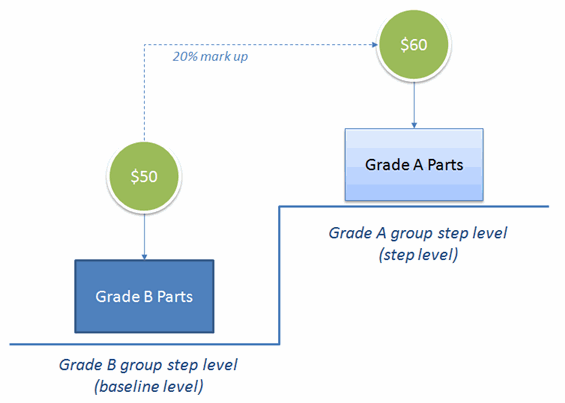
In Servigistics, you align part prices using Group Step Level Pricing by adding a Group Step Level rule to a pricing policy.
Understanding the Effect of Group Step Level Price Alignment
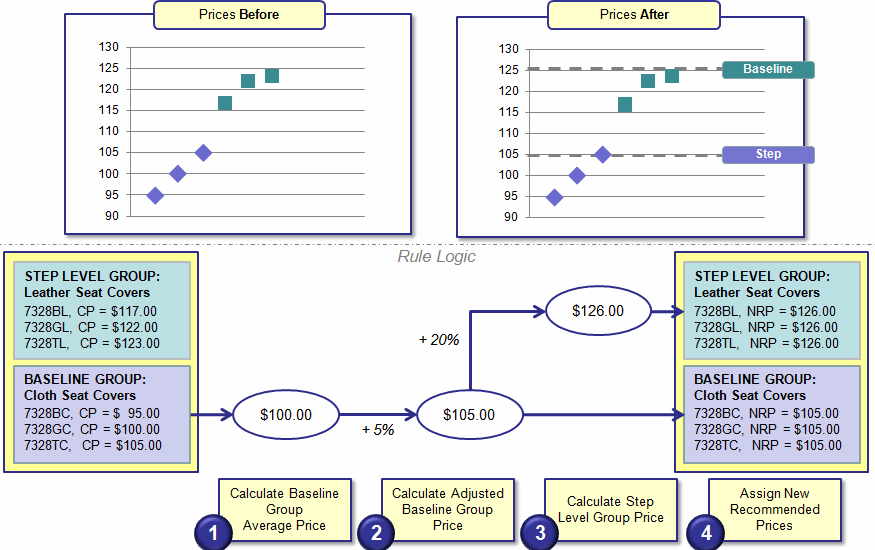
The following diagram shows the effect of Group Step Level price alignment. Notice how the Before scenario shows the baseline group parts and step level group parts at different prices, but the After scenario shows the part prices in each group aligned.
 |
Click here to see more detailed examples of Group Step Level Pricing.
|
Steps in Group Step Level Pricing
Follow these steps to use Group Step Level Pricing.
1. Use the Group Step Levels page to create two group step levels - one for the baseline level and one for the step level.
2. Use the Segments page to create a segment for the parts in the Group Step Levels.
3. Use a pricing policy to align part prices using Group Step Level Pricing
Group Step Level Tasks