Demand and Forecast Aggregation
Overview of Demand and Forecast Aggregation
Internal demand streams contain aggregated external demand from all child locations in a node, while internal forecast streams contain aggregated internal forecasts from all child locations in a node. For example, a location hierarchy has three locations: central, warehouse, and field.
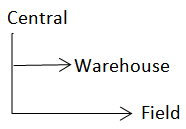
In demand aggregation, the external demand from the field location is rolled into the internal forecast for the warehouse. Then the external demand from the field location and the warehouse is rolled into the internal demand for the central location. The same is true of forecast aggregation; the external forecast from the field location is rolled into the internal forecast for the warehouse, and the external forecast from the field location and the warehouse is rolled into the internal forecast for the central location.
 |
If you plan to run forecast aggregation in 10.7, you must disable forecast netting for all internal streams. Forecast netting can still be run on external streams.
|
The key components of demand and forecast aggregation are as follows:
• Hierarchy: A set of members make up a level and a set of levels make up a hierarchy. In Servigistics, multiple hierarchies can be set up by part or by stream/segment.
• External Demand: External demand is historical demand in each location in the hierarchy. Total external demand for the part, location, stream, or slice is calculated as follows:
historyamount + historyschamount + historycopyamount.
• External Forecast: External forecast is a time-series forecast, based on statistical forecast methods or BOM, that is generated using external demand. The total external forecast for the part, location, stream, or slice is calculated as follows:
forecastamount + forecastschamount + forecastnramount.
• Internal Demand: Internal demand is the sum of external demand from all child locations in a node.
◦ At the aggregate level, internal demand = ∑ (external demand from each child location’s node/member).
◦ At the leaf level, internal demand is 0 or null.
• Internal Forecast: Internal forecast is the sum of external forecasts of all child locations in a node.
◦ At the aggregate level, the internal forecast = ∑ (external forecast from each child location’s node/member).
◦ At the leaf level, internal forecast is 0 or null.
The aggregated demand is stored in the History Amount field of the IPCS_DEMAND_HISTORY table as a separate internal stream - NormalInternal.
Enabling Demand and Forecast Aggregation
Demand aggregation is enabled when the related stream ID of the internal stream is the same as the demand stream ID of the external stream.
To enable forecast aggregation, set the aggregation stream's external indicator flag (ExternalIndicator) to n and set its related stream ID to the forecast stream ID of the external stream.
Limiting Forecast Aggregation to Replenishable Child Locations
In forecast aggregation, rollups can be restricted to replenishable child locations. The global setting, IGNORE_REPLALLOWED_IN_ROLLUPS, controls whether replenishable SKUs will be rolled up when Demand or Forecast Aggregation is run. When set to True, all SKUs will be rolled up. When set to false, only those SKUs where IPCS_PREPROCESSED.ReplAllowed is set to Y will be rolled up. At leaf locations, if IPCS_PREPROCESSED.ReplAllowed is set to N, then demand at that location will not be used in demand aggregation and forecast will not be used in forecast aggregation.
Internal Streams
If the related stream ID is not equal to the forecast stream ID and the external indicator is set to N, then the forecast stream is flagged as internal and both demand and forecasts will be aggregated. Internal streams themselves are created from the gateway, but the relationship can be set up through the gateway or the Stream Configuration Details page.
Demand Bins and Part Chains
Data from demand bins will roll up to the field location and an external forecast will be generated at the field level. The internal demand and the internal forecast will be 0 or null at bin and field locations. Forecasts will not be generated for downchain replacement parts. Rolled up demand from downchain parts will be used when generating internal demand or internal forecasts for the topmost part (TMP) in the part chain.