Forecasting
Predicting the need and consumption of goods in the future can be daunting. With so many variables that can impact the day to day business, it can be difficult to stock the right product at the right location at the right time. Fortunately, Servigistics has a Forecasting module that provides several historical demand-based methods for forecasting future demand that can be applied to individual Part/Locations or segmented groups. It also provides proactive techniques such as Causal/Install-based Forecasting, Service Event-based forecasting, Replacement Rate forecasting, and more.
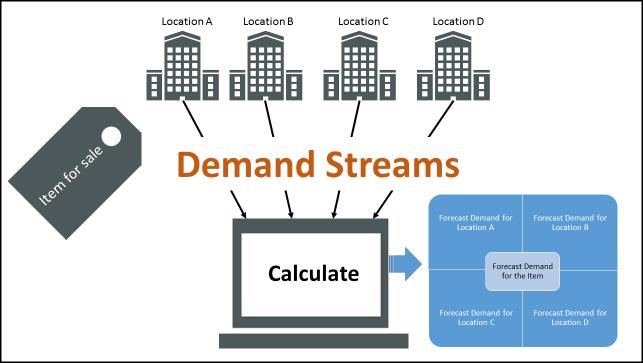
Forecasting effectively requires the prediction of future demand for a part or service at a specific location. Servigistics provides the capability to breakdown demand history data into Demand Streams, allowing each stream to be analyzed individually, and to create a more accurate forecast of future demand behavior. Each location has its own demand forecast for an item that is stocked at that location. By taking those individual demand streams, the forecast for that item can be calculated by location, and also calculated for the item.
Two Factors that Impact Demand Forecast
There are two factors that impact the demand forecast:
• The type of demand (scheduled vs non-recurring)
• The forecast method that was used
Scheduled demand is a predictable pattern of demand. Scheduled demand adjustments, which can be positive or negative, are added to the forecast quantity to arrive at the total forecast quantity used by the application to recommend actions.
Sometimes, however, a forecast adjustment is due to a one-time-only event, a non-recurring event, such as a recall or field change order. If a one-time-only event is added as scheduled demand, it would skew the normal demand trend and improperly increase future forecasts. The application also allows for non-recurring forecast adjustments that prevent one-time-only events from affecting forecasts. Non-recurring forecast adjustments are made to the demand history so that the forecast will not be inflated permanently by an event that not expected to be repeated.
At the end of a slice where a user made a non-recurring forecast adjustment, the application subtracts normal usage from actual demand, making an automatic non-recurring demand adjustment out of the demand stream. Three rules determine how normal usage is defined:
1. If actual demand exceeds the user's non-recurring forecast adjustment, then the user's entire forecast adjustment will be backed out as a non-recurring demand adjustment. The excess of demand over the forecast adjustment is considered the normal usage.
2. If actual demand is less than the user's forecast adjustment, the remaining actual demand is backed out of the demand stream. The calculated forecast quantity forms the normal usage.
3. If actual demand is less than the calculated forecast itself, no adjustment will be made. Actual demand forms the normal usage.
Here are some examples of the rules:
Rule # | Calculated Forecast | Non-Recurring Forecast Adjustment | Actual Demand | Minus "Normal" Usage | = Non-Recurring Demand Adjustment |
1 | 10 | 50 | 75 | -25 | = 50 |
2 | 10 | 50 | 45 | -10 | = 35 |
3 | 10 | 50 | 6 | -6 | = 0 |
The application provides computational forecast methods to generate demand forecasts.
Start using demand forecasting